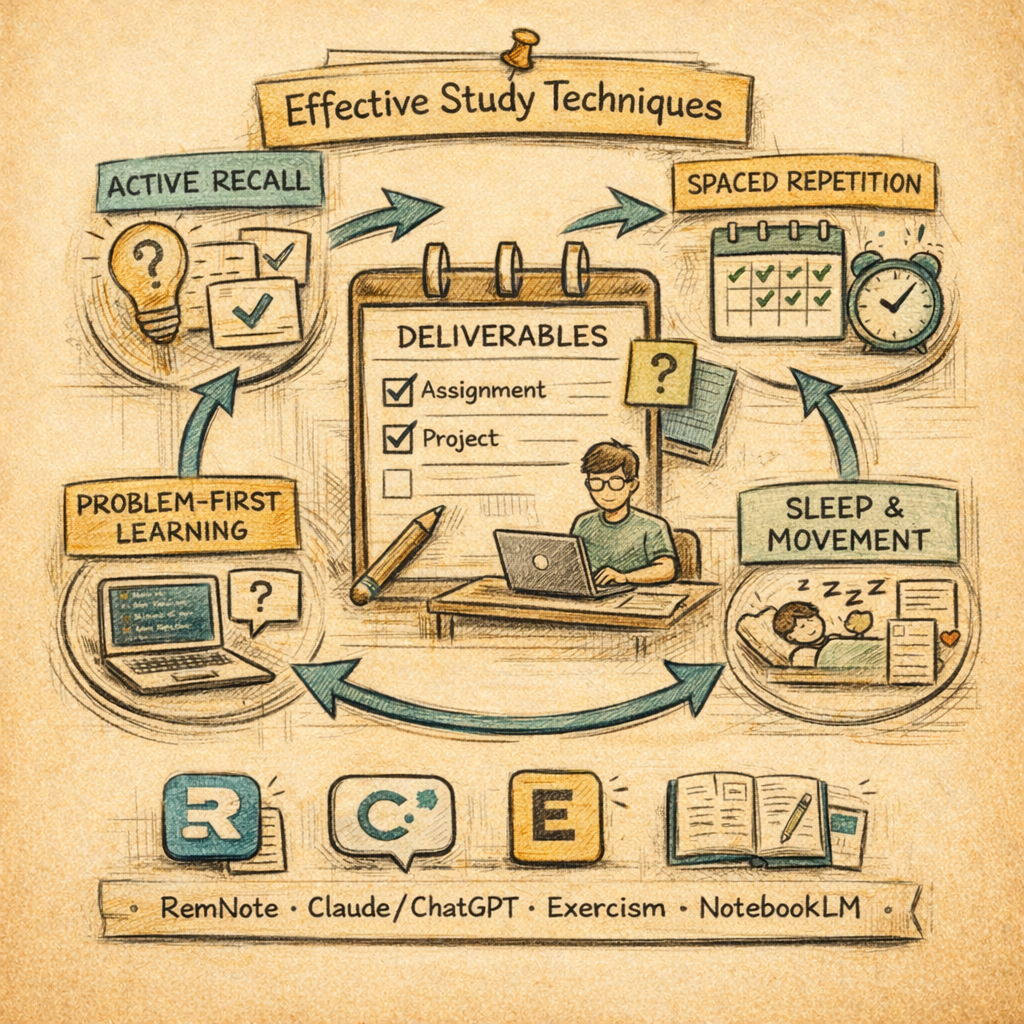
Most people will see this and assume I use AI to cheat, which is… not what I intend.
A while ago, I published my method for learning Computer Science concepts which I called the ARPS study technique. It involved some scientifically proven methods for actually putting in the work it requires to study and remember effectively, and this included:
- Active recall
- Retrieval with spacing
- Problem-first learning
- Sleep and movement
I acknowledge the fact that the post does not address the full picture (I’m not a neuroscientist), but it’s a solid method if we assume some other scientific variables like the actual environment you use to study (your desk, chair, smells, etc), financial stress, emotional state, physical activity, routine, location, age, current job type and a never ending etc. I don’t know how to treat those as there are many things to consider, but one thing is true: If you’re uncomfortable in your immediate environment, can’t concentrate nor remember, there is room for improvement, and the solution depends if some other variables are on their optimal point, besides of the variable you’re measuring.
What I mean by this is that, your location might be right: it’s silent, you have green stuff around, you are positioned in an area where you don’t have to worry about floods or any natural disaster, you have supermarkets around, some entertainment… but your emotional state and financial stress are down, making you less optimal for learning. What do you do? Well, first of all, if you are in this position, seek professional help if needed. Second, you might as well optimize that context, and in doing so you will find difficulties along the way but no price is high to pay than the price of not learning properly, and this is coming from someone who values learning above all things.
However, I didn’t talk about any of the tools I use to get better at what I do, which is essentially, programming, systems thinking, data structures and mathematics. In this post, I will list all of the tools I use and how I use them to show the real path to study Computer Science effectively.
First, I am clear on my deliverables (Not AI yet)
Deliverables are the quantifiable goods or services that will be provided once a project is complete. In university, assignments are deliverables, and a deep understanding of them will lead the way to a better outcome on anything I have to accomplish. This structured way of learning becomes my guidance to success. If I didn’t have a clear structure, I’d do my best to create one.
Computer Science is extremely demanding, we need many skills that require us to think deeply about problems so we need to carefully understand what’s required first. Every week I set one tangible deliverable. Even a small deliverable creates momentum and reveals what I truly understand.
RemNote
This is the superstar. RemNote is an AI tool I use to practice flashcards. They use spaced repetition and active recalling to help me study better and efficiently. Their AI tutor makes it easier to build flashcards automatically, but you can also create your own cards.
The app lets you create exam study sessions, upload documents from your computer or scan websites and adjust your preferred timing for flashcards when you forget or remember something. I use RemNote as my main platform to actually study and ask questions for topics I don’t understand. The documents and knowledge resource I feed it is the one that’s being used by the AI Tutor, so there are no hallucinations here.
I used to use Atlas.org, but they didn’t have spaced repetition like RemNote does. The value proposition is another that doesn’t fit my needs, so I stopped using them.
NotebookLM
I use this one for research. Any assignments, request or question I have, I use NotebookLM. This platform also have flashcards and other interesting tools in their studio tab, like slide decks, flashcards and infographics, but I honestly don’t use any of those.
The prompt I use to do research can be broad to manually consider what I want, or specific to narrow down the sources on deep research.
If the topic is binary trees, I use the fast research to “look for high quality websites that talk about binary trees”, then I manually read page by page to see what works and what doesn’t.
If the topic is related to evidence gathering, I’d use deep research
Claude/ChatGPT
RemNote credits are limited, 20k in the pro version, and though it may sound like a lot, it’s not. 140 credits are wasted just for expanding a book’s section (6 by default) and flashcard creation, so I need to use Claude or ChatGPT to help me understand some concepts effectively, asking dumb question after dumb question (that’s my favorite part) until I get it.
Also, I can use all of their capabilities like deep research, frontier models, Codex or Claude Code (I prefer Codex), artifacts, shopping assistance, etc… So that’s a big plus.
I don’t use many prompts for studying from all those prompts out there they suggest. I use basic compare/contrast certain topics to understand the difference and I like explaining in my own words what I understand by “binary trees” as extensive as I can to get feedback. Some examples here and there, analogies and “explain this as if I were 12”. That’s it.
Exercism
This is not fully AI, it’s a coding platform, but they use AI to get explanations on stuff. However, it’s important to include it in this list because this is a non-negotiable for practicing my coding skills and keep them fresh. I do it lightly everyday to avoid forgetting.
That’s it
This is basically my AI stack for studying. It’s not glamorous or fancy, but it works. Right now, this is a robust system for me because a) I remember stuff, b) I study everyday, c) research and have complete information and d) it helps me understand topics deeply. By leveraging these tools, I maintain good grades at university, The worst grade I had was B+, but the idea is always A+.