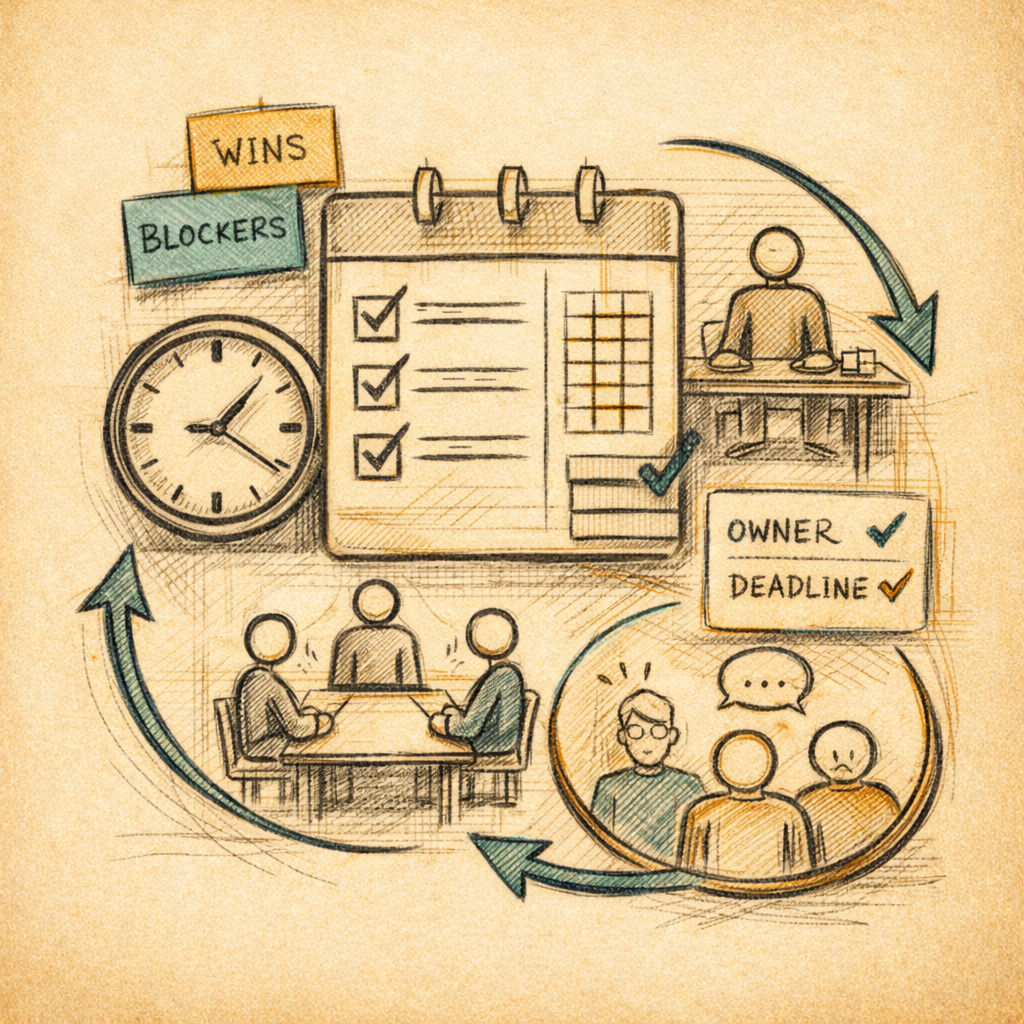
The title is most definitely fancy, but it’s just a weekly meeting. Most weekly meetings I had felt weird. The founders met and discussed each topic as scattered notes: status updates, decisions, problem solving and extremely vague planning. I saw this and decided to turn it around to something better: wins, blockers, decisions needed, metric changes and owner commitments. Each segment has a time limit and a clear output set in the Teams meeting agenda. If a discussion needs deeper work, we create another sessions for it.
Make ownership visible every week
The most valuable part of the review is commitment tracking. Every important item ends with an owner and a deadline. It sounds like nothing new but it changes meeting quality immediately. Ambiguity disappears when responsibility is explicit, there’s no way around it.
It also builds trust. People stop pretending everything is fine and start bringing up real problems, because the meeting actually helps move things forward instead of just being a routine.
Keep the meeting small and decision-oriented
If too many people join, the review becomes reporting. I keep it limited to the people who can unblock work or own outcomes. Information can be shared asynchronously, though I understand some bosses don’t like that.
A weekly operating review should protect momentum. If it does not improve decision speed, it needs redesign.